

Investors are increasingly converting traditional long-term rental (LTR) properties into short-term listings, and the shift is reshaping housing availability in cities across the country. For landlords and property owners, understanding this trend matters because it affects rental pricing, vacancy rates, and the competitive landscape for both new and existing investment properties.
Below, we cover the forces pushing investors toward short-term conversions, the ripple effects on LTR supply, where local regulations stand, and a practical framework for weighing which rental strategy actually fits a given property.
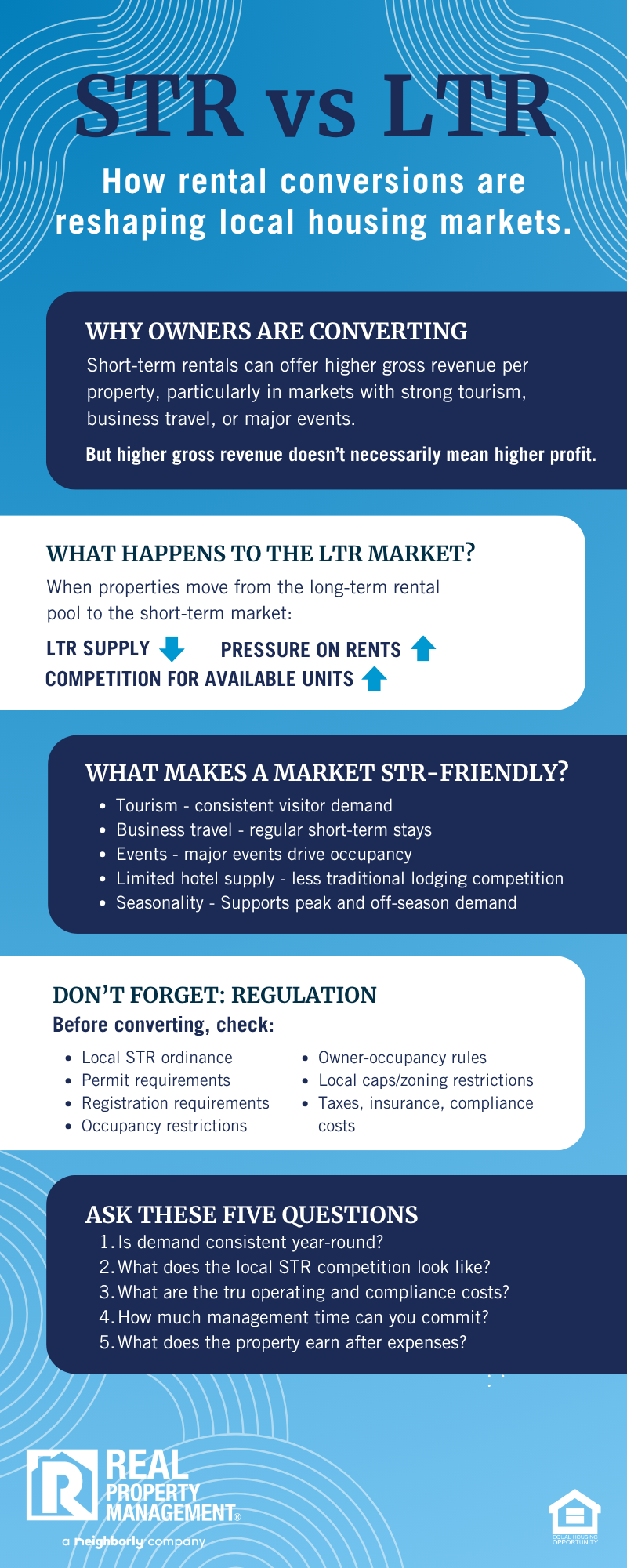 What Is a Short-Term Rental Conversion?
A short-term rental (STR) conversion occurs when a property owner takes a unit that was previously leased to a long-term tenant and instead lists it on a platform like Airbnb or Vrbo. In Colorado, for instance, state law defines any rental of a lodging unit for fewer than 30 days as an STR, regardless of whether the platform markets it as a vacation rental or a home share. Owners make this switch for one primary reason: in many markets, STRs have historically generated higher gross revenue per unit than a traditional annual lease.
The conversion trend accelerated over the past several years as more investors treated rental property as an active business rather than a passive income stream, and as short-term rental platforms made it easier to manage bookings, pricing, and guest communication remotely.
 How Short-Term Rental Growth Is Reshaping Long-Term Rental Markets
When a meaningful share of the housing stock shifts out of the long-term pool, the remaining supply shrinks, and researchers have quantified how that shift directly shows up in rent. A 2025 analysis of ZIP code-level data across 27 U.S. cities found that STR regulations, which reduced listings by 40% on average, correspondingly eased rents and home values by an estimated 5%, underscoring how closely STR supply and LTR affordability are connected.
Landlords in markets with a heavy STR concentration often see this play out in three ways:
- Fewer available units: For long-term tenants, this increases competition for the remaining units.
- Upward pressure on long-term rents: Remaining landlords can charge more when supply shrinks relative to demand.
- Higher home prices in areas popular with tourists or rich in local amenities: Investor demand for properties eligible for STR use is one factor pushing valuations upward in these pockets
For property owners weighing a conversion, it helps to understand whether this growth trend is likely to continue or level off in a given market before making a long-term decision.
The Investor Case for Short-Term Rental Conversions
Broader rental market conditions shape how attractive a conversion looks in any given year. Rental demand has remained strong nationally, and a recent report from a research center found that apartment demand hit a record annual increase of 784,000 households as of the second quarter of 2025 before cooling later in the year, a pace that keeps overall rental markets constrained even as STR supply grows alongside it.
That combination, limited long-term supply paired with continued short-term rental growth, means investors evaluating a conversion now need to look closely at local occupancy trends, seasonal demand patterns, and daily rate performance rather than assuming a short-term listing will automatically outperform a long-term lease.
Markets with strong tourism demand, limited hotel inventory, or major event calendars tend to support conversions better than markets with thinner demand or more seasonal demand. A property that performs well as a short-term rental in a beach town during summer months may sit largely vacant in the off-season, a pattern long-term tenants don’t create.
How Cities Are Regulating Short-Term Rental Growth
Regulatory response has become one of the biggest variables in the conversion decision, and rules vary significantly from city to city. Many municipalities now require registration, cap the share of housing stock eligible for STR use, or restrict conversions to owner-occupied units.
Boston offers one of the clearest examples of how much a single ordinance can reshape a local market. Following the city’s STR rules, a university research center found that the regulations led to a 56% reduction in short-term rental listings citywide. However, the research also found that professional hosts and management companies still account for the majority of the remaining supply.
That kind of regulatory tightening can push converted units back into the LTR pool, sometimes abruptly, which affects both rental supply and pricing in the surrounding market. Property owners considering a conversion should research local ordinances carefully, since a market that’s currently permissive can change direction within a single legislative cycle.
How To Evaluate Short-Term Vs Long-Term Rentals
Deciding whether a property performs better as a short-term or long-term rental requires weighing several factors together rather than focusing on gross revenue alone.
- Local supply conditions: Markets with constrained housing supply tend to see the sharpest rent effects from conversions, and separate national research found that a 10% increase in a ZIP code’s housing supply correlated with rents growing roughly 1.4% more slowly than in areas without that added supply
- Compliance costs: STR often carry annual permit fees, registration requirements, and platform fees that have increased in recent years, on top of standard property taxes and insurance
- Occupancy consistency: LTR provides predictable, contracted income, while STR depends on booking volume that can swing with seasonality and local competition
- Management demands: STR requires more active involvement, from guest communication to frequent turnover cleaning, compared to the lower-touch structure of an annual lease
- Local demand drivers: Properties near strong, consistent tourism or business-travel demand tend to support short-term conversions better than properties in primarily residential areas
Property owners who run these factors against their specific market and property type are better positioned to make a conversion decision based on realistic performance rather than on headline revenue figures from another market.
Frequently Asked Questions About STRs and LTRs
What's driving the shift from long-term leases to nightly rentals?
Short-term rentals have historically offered higher gross revenue per unit than a traditional annual lease, and platforms have made it easier to manage bookings and guests remotely, which has drawn more investors toward treating rental property as an active business rather than passive income.
Does short-term rental growth actually affect long-term rent prices?
Yes. When housing stock shifts out of the long-term pool, the remaining supply shrinks, and research has linked short-term rental regulation directly to changes in local rents and home values, showing how closely the two markets are connected.
Are short-term rental regulations the same in every city?
No. Rules vary significantly by location, and some cities require registration, cap the share of eligible housing stock, or restrict conversions to owner-occupied units. A market that’s permissive today can tighten quickly, as seen in cities that adopted stricter ordinances.
How do you decide between a nightly rental and a long-term lease?
It depends on local supply conditions, compliance costs, how consistent the occupancy needs to be, how much hands-on management you’re able to take on, and whether the property sits near strong, steady demand from tourism or business travel.
The Bottom Line for Property Owners
Short-term rental conversions will likely continue shaping LTR markets, but the pace and impact vary widely by city, regulatory environment, and local demand.
Owners who track these dynamics closely, rather than reacting to national averages, are best positioned to decide whether their properties belong in the LTR pool or the short-term market.
If you’d like guidance on navigating the changing rental landscape, or want to see how expert management with Real Property Management Sugarland can help you optimize your investment, reach out today. Our team can provide local insights, tailored recommendations, and support for your specific goals.
This content is provided for general informational and educational purposes only and does not constitute financial, legal, tax, or investment advice. Readers should consult with licensed professionals regarding their specific circumstances.
We are pledged to the letter and spirit of U.S. policy for the achievement of equal housing opportunity throughout the Nation. See Equal Housing Opportunity Statement for more information.
